The Real AI Efficiency Gap: Faster Execution, Same Strategic Bottlenecks.
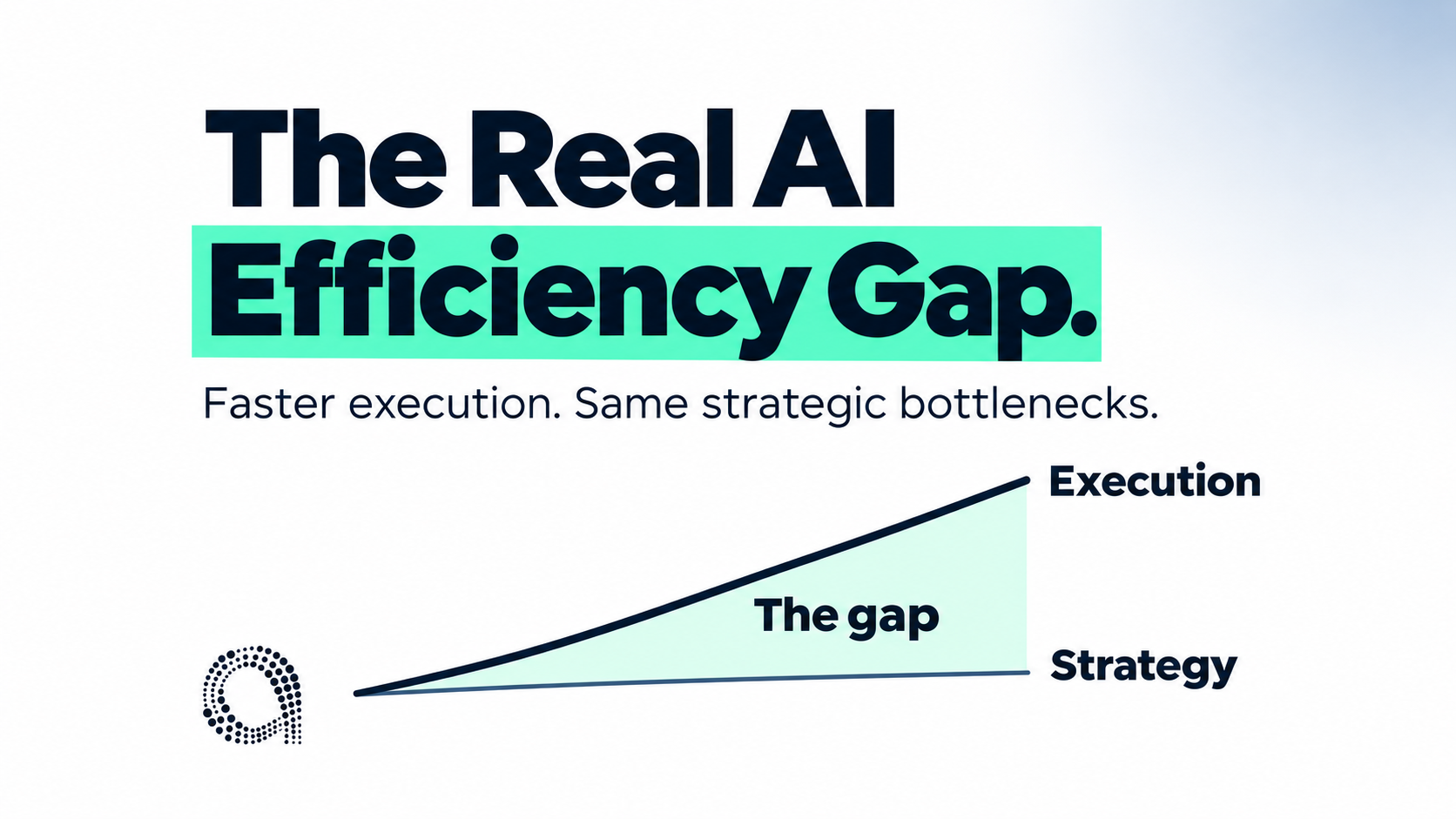

AI has made procurement tasks faster, but for most teams the category strategy—the long-term plan to maximize value and manage risk in a specific spend area—is no closer. The time saved leaks into new work, open-ended preparation, and strategies regenerated from scratch. This article explains where the speed goes, what research from Gartner and Harvard Business Review shows, which three measures reveal real strategic progress, and five questions to judge a strategy before the results arrive.
Picture a packaging category team on a Monday. AI has already done a lot of work for them. Multiple documents are ready: a fresh spend summary (a detailed breakdown of historical expenditure by supplier and category), several versions of a market report and a supplier risk overview. Each one took minutes rather than days.
The strategy meeting is on Thursday. It will probably move again, because nobody has decided yet whether to consolidate suppliers (the process of reducing the total number of vendors to increase leverage and reduce complexity). The team is busier than ever, and the strategy is where it was last quarter.
Why hasn’t AI made procurement more efficient?
AI has not made procurement more efficient at the team level because most of the speed stays inside individual tasks and never reaches the category strategy. Faster spend summaries and market scans save time for one person, but the team still decides at the same pace, so the strategy moves no faster than before.
The research aligns with this observation. A Gartner survey conducted in early 2026 among 101 Chief Procurement Officers revealed that Generative Artificial Intelligence (GenAI)—which creates new content by learning from patterns in training data—boosted individual productivity in terms of time saved, output volume, and quality. However, these improvements significantly diminished at the team level. Gartner refers to this as the AI productivity paradox: AI accelerates individual tasks but does not translate into substantial gains for the team or organization as a whole. Only 36% of the surveyed CPOs were very confident in their ability to redesign roles and processes to fully integrate AI.
So the speed is real. It just doesn’t add up to a better category strategy on its own. In our experience, it leaks out in three places.

Leak 1: Where does the time saved by AI go?
Some of the time AI saves in procurement goes into new work. A faster task often produces something that someone else now has to read, check, or align: an extra version of a report, or a summary so long it needs a summary of its own.
Researchers from BetterUp Labs and the Stanford Social Media Lab, writing in Harvard Business Review, call this workslop: AI-generated content that appears polished but lacks real substance, shifting the work onto colleagues. In their study, 41% of the workers surveyed had run into it, and each case took nearly two hours of rework on average.
In a category team, it looks familiar. A market report arrives in minutes, so a second version gets requested. A supplier summary is long, so someone writes a summary of the summary. Each step is fast. Together they fill the week.
The way out is not to produce less, but to give the work a structure. When each analysis answers a question the strategy actually needs, a fast output has somewhere to land instead of becoming another document to read.
The cost: the hours saved on one task are spent on the tasks it created. The strategy work gets what is left.
Leak 2: Why does category strategy stay stuck in preparation?
A category strategy stays stuck in preparation because preparation has no natural end. Every analysis raises a new question, and AI makes each one cheap to chase. The team keeps learning, but the decisions the strategy depends on stay open.
When a market scan takes minutes, it is tempting to run another, then a deeper one on a sub-segment, then a comparison with last year. The team learns a lot. But the question that matters for the strategy, such as whether to consolidate, dual-source, or renegotiate, stays open.
The fix is not less analysis. It is analysis with a direction. A proven category management method gives that direction: it defines what each stage of the strategy needs before the team moves on. Before the next analysis, ask what the team needs to know to take the next strategic step, not what else it could learn.
The cost: a category that is always well researched and never decided.
Leak 3: Should you regenerate your category strategy every cycle?
Regenerating a category strategy with AI every cycle looks efficient, but it usually isn’t. Many organisations still treat the strategy as an annual document that is written, filed, and reopened at the next refresh. AI makes it easy to skip the reopening and generate a new market scan, new analysis, and new slides instead.
What gets lost is last year’s reasoning. Why did the team accept a single source for that component? Which stakeholder—an individual or group within the business whose requirements are affected by the category—pushed back on the price index, and what did they agree? A regenerated document doesn’t know. The team spends the refresh re-checking what it already knew.
The alternative is a strategy that lives in one place. Stakeholder priorities, analyses, the chosen levers, and the initiatives that follow are connected to each other, and the initiatives keep being tracked after the strategy is approved.
The cost: every cycle starts close to zero, so the strategy never compounds.
How should procurement measure AI efficiency?
Procurement teams can measure AI efficiency by tracking strategic progress: how quickly they move from first analysis to an agreed direction, how many strategic questions they resolve, and how many categories have a current strategy.
Deloitte’s 2021 survey reported that procurement teams spent 74% of their time on transactional and operational activities. That finding puts the focus on what happens to the time AI saves: can teams use it to move category strategy forward? (Deloitte’s 2021 Global Chief Procurement Officer Survey, p. 28)
Three measures can help answer that question:
- Time from plan to strategy: How long it takes a category team to move from first analysis to an agreed direction.
- Decisions closed: How many open strategic questions the team resolves per cycle.
- Strategic coverage: The share of categories with a current strategy that the team owns.
A category lead can start tracking all three for a handful of categories this quarter using the tools the team already has.
How do you judge a category strategy before the results come in?
Judge the method, not the presentation or the year that follows. Before sign-off, a strategy is often judged on how polished it looks; a year later, on its results. Neither shows the quality of the thinking: a strong deck can rest on one untested assumption, and a good strategy can still meet a bad year.
Science offers a useful model. Peer reviewers don’t ask whether they like a paper’s conclusion. They ask whether the method could support it, and whether someone else could follow the reasoning and check it. Five questions bring that to category strategy:
- Are facts and judgements kept apart, so a reviewer can tell which is which?
- Were real alternatives compared, and is it clear why the chosen one won?
- Could each objective be proven wrong within twelve months?
- Are the key assumptions written down, each with a signal that would show it no longer holds?
- Would the team running the next tender know which decisions the strategy has already made?
None of these needs hindsight. A strategy that passes them can still miss, because markets surprise everyone, but the team can see why and the next one improves. A strategy that fails them can still hit its numbers, and nobody learns whether that was skill or luck.
What does a head start on strategy look like?
A head start on strategy means the team arrives at the strategy discussion with the groundwork in one place and only the real decisions left open: what the business needs from the category, what the market looks like, and which options are on the table.
From there, the team spends its time where judgement matters: weighing trade-offs, testing assumptions with stakeholders, and deciding.
This is the thinking behind akiro, the Strategic Category Management (a structured process that aligns procurement activities with broader business goals) platform from akirolabs. It builds category strategy on an established methodology, connects every initiative back to a value lever (a specific strategic action used to generate savings or performance gains), an objective, and a company priority, keeps tracking it after approval, and leaves the decisions with the team. Its value isn’t the number of things it produces. It is how clearly a team can see its next real step, and show why it chose it.
Speed is only half of the question. The other half is whether AI helps procurement teams make better decisions.
FAQ
What is akiro?
akiro is the Strategic Category Management platform from akirolabs. It takes a category strategy through three phases—Analyze, Strategize, and Realize (the stages of moving from data gathering to strategic decision-making and execution)— so the work happens in one place instead of being spread across spreadsheets and slide decks.
How does akiro help a team reach a decision, not just more analysis?
Each analysis in akiro, from business objectives and spend to market forces, risks, and supplier relationships, answers one question the strategy needs. Stakeholder priorities then feed scenarios with value levers the team can compare, and the category manager chooses the direction.
How does akiro connect a category strategy to company priorities?
Every task traces back to an initiative, a value lever, the chosen scenario, a business objective, and a company priority. That makes it clear to leadership and finance why each step is in the plan.
What happens after a category strategy is approved in akiro?
The strategy keeps working. Initiatives have owners, dates, and forecast financial effects, and the team tracks progress and the value actually delivered for the life of the strategy.
Does akiro replace the category manager’s judgement?
No. akiro structures the work and keeps the analysis in one place. The category manager weighs the trade-offs and decides, and stakeholder priorities are confirmed with the stakeholders themselves.
How do you evaluate the quality of a category strategy?
Judge the method before the results: facts kept apart from judgements, real alternatives compared, objectives that could be proven wrong within a year, key assumptions written down with a signal for each, and decisions the next tender team can see.
How do you measure whether AI is improving category strategy?
Track time from plan to strategy, the number of open strategic questions closed per cycle, and the share of categories with a current, owned strategy.
Sources
- Harvard Business Review: AI-Generated “Workslop” Is Destroying Productivity
- Deloitte: Agility: The antidote to complexity, 2021 Global Chief Procurement Officer Survey


























































































What makes a successful pilot with akirolabs?
We define success collaboratively with your team. Typical outcomes include strategy creation for priority categories, measurable process improvements, and internal alignment. We provide full support and a clear roadmap for evaluation.
Can I try the platform hands-on after the demo?
Yes, we offer guided pilots and sandbox environments depending on your stage in the buying process. These give you and your team the opportunity to explore features in your own context.
Can I see how akirolabs would work with our specific categories?
Yes, we can tailor the demo to showcase how akirolabs works with your specific categories and procurement structure. Let us know your priority areas in advance, and we'll customize the demonstration accordingly.
Who should attend the demo from my organization?
We recommend including key stakeholders from your procurement leadership team, category management function, and procurement excellence or transformation groups. Including business stakeholders can also be valuable to demonstrate how the platform facilitates cross-functional collaboration.
How long does a typical demo take?
A standard demo takes approximately 45-60 minutes, allowing time for a comprehensive overview of the platform and discussion of your specific requirements. We can adjust the timing based on your availability and areas of interest.
What will I see during an akirolabs demo?
During the demo, you'll see the complete akirolabs Category Strategy Workbench in action, including the collaborative workflow, AI-powered insights from akiroAssist, strategic scenario modeling capabilities, and the Strategy One-Pager feature. We'll customize the demonstration to focus on aspects most relevant to your organization's needs.
Ready to Transform Your Procurement Strategy?
There’s a better way to do procurement. This is IT.