Outsmart Uncertainty: How Procurement Teams Build Living Category Strategies
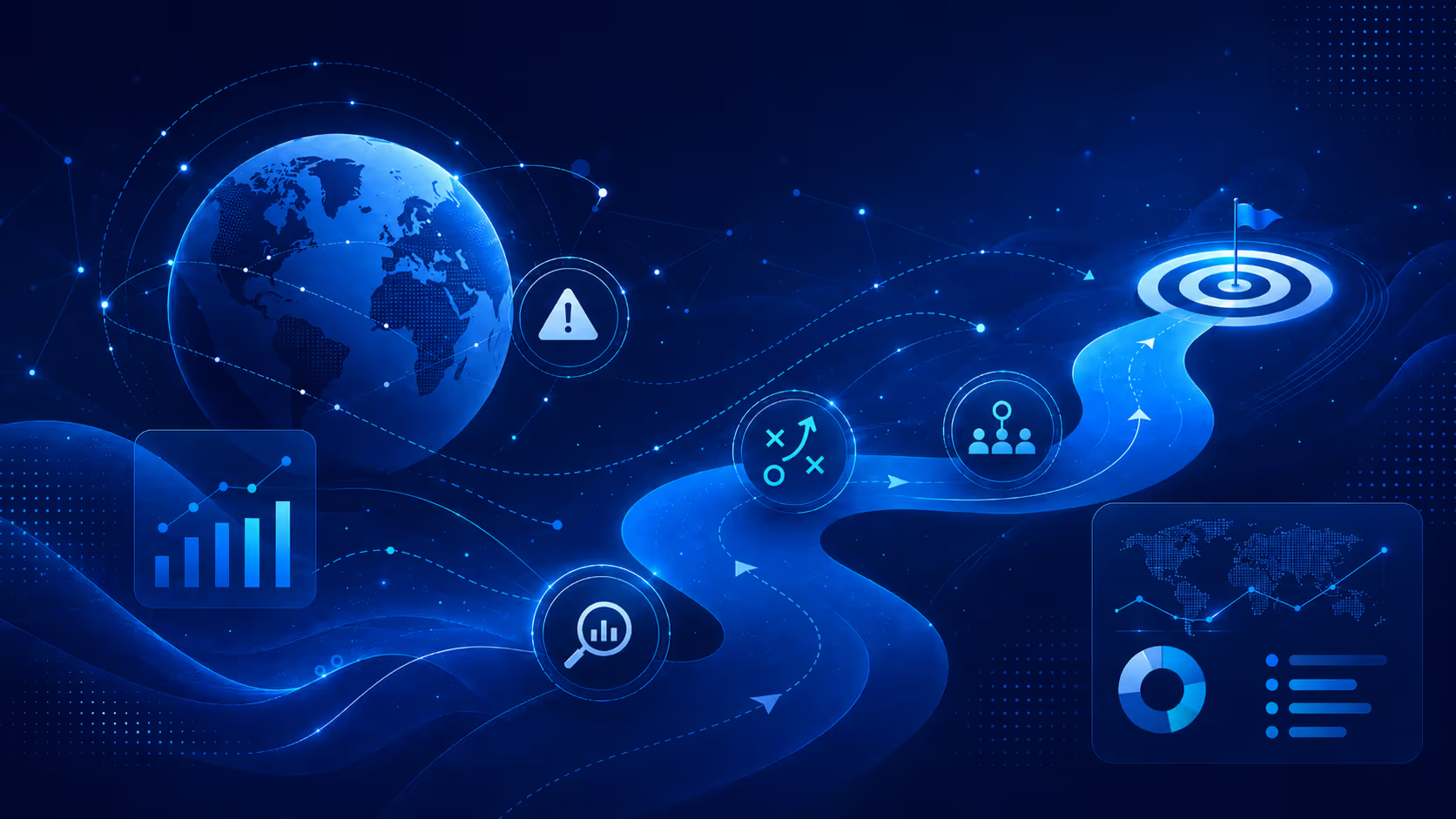

The real shift sits in the way procurement teams think about strategy. Cost still matters, but cost alone no longer defines value. Procurement now needs to protect continuity, strengthen resilience, support sustainability, and help the business make better decisions under pressure.
Watch the full webinar: https://watch.getcontrast.io/register/akirolabs-outsmarting-uncertainty-how-leading-teams-navigate-category-complexity-and-risk?utm_source=website&utm_medium=organic&utm_campaign=outsmarting+uncertainty
Uncertainty becomes part of the operating environment
Procurement teams see repeat patterns in uncertainty. Events across regions and markets keep showing similar effects on logistics, supply availability, lead times, and cost. The lesson is clear: disruption no longer feels like an exception. It becomes part of the environment.
That reality changes the role of category management. A strategy that only reflects historical spend and a once-a-year review cycle cannot keep up. Markets move faster than planning cycles, and by the time a category strategy receives approval, a new event can already change the picture.
Why static category strategies become “zombie strategies”
A category strategy can look complete on paper and still fail in practice. It has slides, saving targets, supplier initiatives, and a roadmap. Yet it does not sense change, it does not adapt quickly, and it does not help teams make better decisions when disruption arrives.
That kind of strategy becomes a zombie strategy: technically alive, but not truly active.
A living category strategy does more than record goals. It stays connected to market changes, risk signals, and business needs. It supports continuous decision-making instead of annual reporting alone.

Cost still matters, but value comes first
Cost remains important. Savings still matter, and boards still ask for them. But cost alone cannot define the full value of procurement.
A cost-first strategy can create exposure. A single-source dependency may look efficient until a disruption blocks supply. Then the low-cost choice becomes expensive. Procurement teams need to ask a sharper question:
Are we optimizing costs, or are we protecting the value of the company?
That shift changes the category strategy conversation. Instead of focusing only on the cheapest supplier or the best price after an RFP, procurement teams also ask:
- How resilient is the supply base?
- How quickly can the team react when something breaks?
- What does it cost if delivery fails?
- How reliable are suppliers?
- How does the category support continuity under pressure?
Cost still matters, but it needs context.
The new procurement mindset: from cost-first to value-driven
A value-driven mindset does not abandon cost. It adds the other value contribution targets that procurement delivers:
- resilience
- continuity
- reliability
- sustainability
- collaboration
- strategic flexibility
This mindset helps procurement teams move from short-term optimization to long-term protection and growth. It also changes how organizations measure success. Savings alone no longer tell the full story. The real goal sits in helping the business adapt, recover, and move forward.
The analyze, strategize, realize framework
A living strategy needs structure. One practical framework follows three connected phases:
1. Analyze
Analysis needs to go beyond spend and contracts. Procurement teams need internal and external signals, including:
- supplier exposure
- market volatility
- geopolitical signals
- risk alerts
- market intelligence
- supplier performance data
Traditional spend analysis shows where the money goes. Modern analysis shows where risk and exposure build.
2. Strategize
The strategize phase needs scenario planning. A strategy should not rely on only one version of the future. Procurement teams need to compare strategic options and understand the trade-offs between them.
Examples of scenario questions include:
- What happens if demand increases suddenly?
- What happens if a supplier faces capacity issues?
- What happens if transport routes become unstable?
- What happens if a region turns risky?
- What happens if sustainability constraints change?
This approach makes strategic options clearer. It also helps teams choose between alternatives such as qualifying a second supplier, changing contract structures, or redesigning specifications.
3. Realize
The realize phase turns the strategy into action. Procurement does not carry this alone. Cross-functional alignment matters.
Finance, supply chain, operations, R&D, legal, and other business functions all need to understand the direction, the trade-offs, and the value levers. Procurement becomes the connector across the business, not only the function that manages suppliers and negotiations.
AI supports analysis, but people make the strategic call
Procurement teams often already hold the data they need. Spend data, supplier performance data, market reports, risk alerts, internal notes, and other signals exist across different systems and formats. The challenge does not sit in the lack of data. The challenge sits in the fragmentation of that data and the speed needed to make sense of it.
This is where AI helps.
AI can:
- read patterns across sources
- summarize context
- detect repeated topics
- connect signals across regions and business units
- accelerate the analysis process
AI should not make the strategic call. The decision belongs to the category team. Human intelligence stays at the center, while AI improves speed, clarity, and confidence.
Scenario planning makes trade-offs visible
Scenario planning helps procurement teams avoid abstract discussions about risk. Instead of saying “we need to reduce risk,” teams can compare concrete options side by side.
That brings sharper questions:
- Do we qualify a second supplier?
- Do we redesign specifications?
- Do we change contract structures?
- Do we accept more flexibility or more resilience, and at what cost?
This is where strategy becomes more mature. Procurement teams do not only choose between efficiency, resilience, or sustainability. They decide consciously what matters most and what the organization can afford in exchange for that choice.
Cross-functional collaboration strengthens execution
A strategy only works when the organization acts on it. That means procurement needs more than insight. It needs governance, leadership support, and the mandate to work across functions.
In practice, this means:
- setting a clear cross-functional governance structure
- bringing stakeholders into the strategy early
- making the business objectives visible
- aligning on key value levers
- reviewing the strategy regularly
- adapting the plan when market conditions change
Procurement becomes the strategic driver of the category and the cross-functional team. That shift changes how the business sees the function.
What organizations gain from stronger procurement strategy
When procurement combines better intelligence, sharper trade-offs, and stronger execution, the organization gains:
- fewer surprises
- earlier risk detection
- less firefighting
- better business conversations
- faster decisions
- stronger continuity under pressure
The result does not stop at savings. The result includes a procurement function that helps the business make better decisions and act with confidence in uncertain conditions.
Final thought
The future of category strategy does not sit in static slides or annual reviews. It sits in living strategies that analyze continuously, strategize through scenarios, and realize through cross-functional action.
In a world of repeated disruption, procurement stays strongest when it moves beyond cost-first thinking and builds value, resilience, and continuity into every category strategy.

Christian Herdelt ist Director of Customer Success bei akirolabs, wo er es Einkaufsteams ermöglicht, mit KI-gestützter digitaler Kategorienstrategie herausragende Leistungen zu erbringen. Christian stützt sich auf seine Erfahrung bei der Transformation des Einkaufs bei Keelvar und IBM und stellt sicher, dass Kunden den vollen Nutzen aus der datengestützten Zusammenarbeit ziehen, und macht die Beschaffung zu einem strategischen, wirkungsvollen Geschäftspartner.


















































































.avif)




Was macht ein erfolgreiches Pilotprojekt mit Akirolabs aus?
Wir definieren Erfolg gemeinsam mit Ihrem Team. Zu den typischen Ergebnissen gehören die Strategieerstellung für Prioritätskategorien, messbare Prozessverbesserungen und interne Abstimmung. Wir bieten volle Unterstützung und einen klaren Zeitplan für die Bewertung.
Kann ich die Plattform nach der Demo praktisch ausprobieren?
Ja, wir bieten geführte Piloten und Sandbox-Umgebungen an, je nachdem, in welcher Phase des Kaufprozesses Sie sich befinden. Diese geben dir und deinem Team die Möglichkeit, Funktionen in deinem eigenen Kontext zu erkunden.
Wer sollte an der Demo meiner Organisation teilnehmen?
Wir empfehlen, wichtige Stakeholder aus Ihrem Führungsteam für die Beschaffung, aus der Kategorie Management und aus den Gruppen für Exzellenz oder Transformation im Bereich Beschaffung einzubeziehen. Die Einbeziehung von Interessenvertretern aus dem Unternehmen kann auch hilfreich sein, um zu demonstrieren, wie die Plattform die funktionsübergreifende Zusammenarbeit erleichtert.
Was werde ich während einer Akirolabs-Demo sehen?
Während der Demo sehen Sie die komplette Akirolabs Category Strategy Workbench in Aktion, einschließlich des kollaborativen Workflows, der KI-gestützten Erkenntnisse von AkiroAssist, der Funktionen zur strategischen Szenariomodellierung und der Strategy One-Pager-Funktion. Wir passen die Demonstration so an, dass sie sich auf Aspekte konzentriert, die für die Bedürfnisse Ihres Unternehmens am relevantesten sind.
Kann ich sehen, wie Akirolabs mit unseren spezifischen Kategorien funktionieren würde?
Ja, wir können die Demo so anpassen, dass sie zeigt, wie Akirolabs mit Ihren spezifischen Kategorien und Ihrer Beschaffungsstruktur zusammenarbeitet. Teilen Sie uns Ihre Schwerpunktbereiche im Voraus mit und wir passen die Demonstration entsprechend an.
Wie lange dauert eine typische Demo?
Eine Standarddemo dauert etwa 45-60 Minuten und bietet ausreichend Zeit für einen umfassenden Überblick über die Plattform und eine Diskussion Ihrer spezifischen Anforderungen. Wir können den Zeitplan an Ihre Verfügbarkeit und Ihre Interessengebiete anpassen.
Sind Sie bereit, Ihre Beschaffungsstrategie zu transformieren?
Es gibt einen besseren Weg, die Beschaffung zu erledigen. Das ist IT.
.avif)